

Electric Vehicle Transition Set to Accelerate Global Tyre Waste Challenge
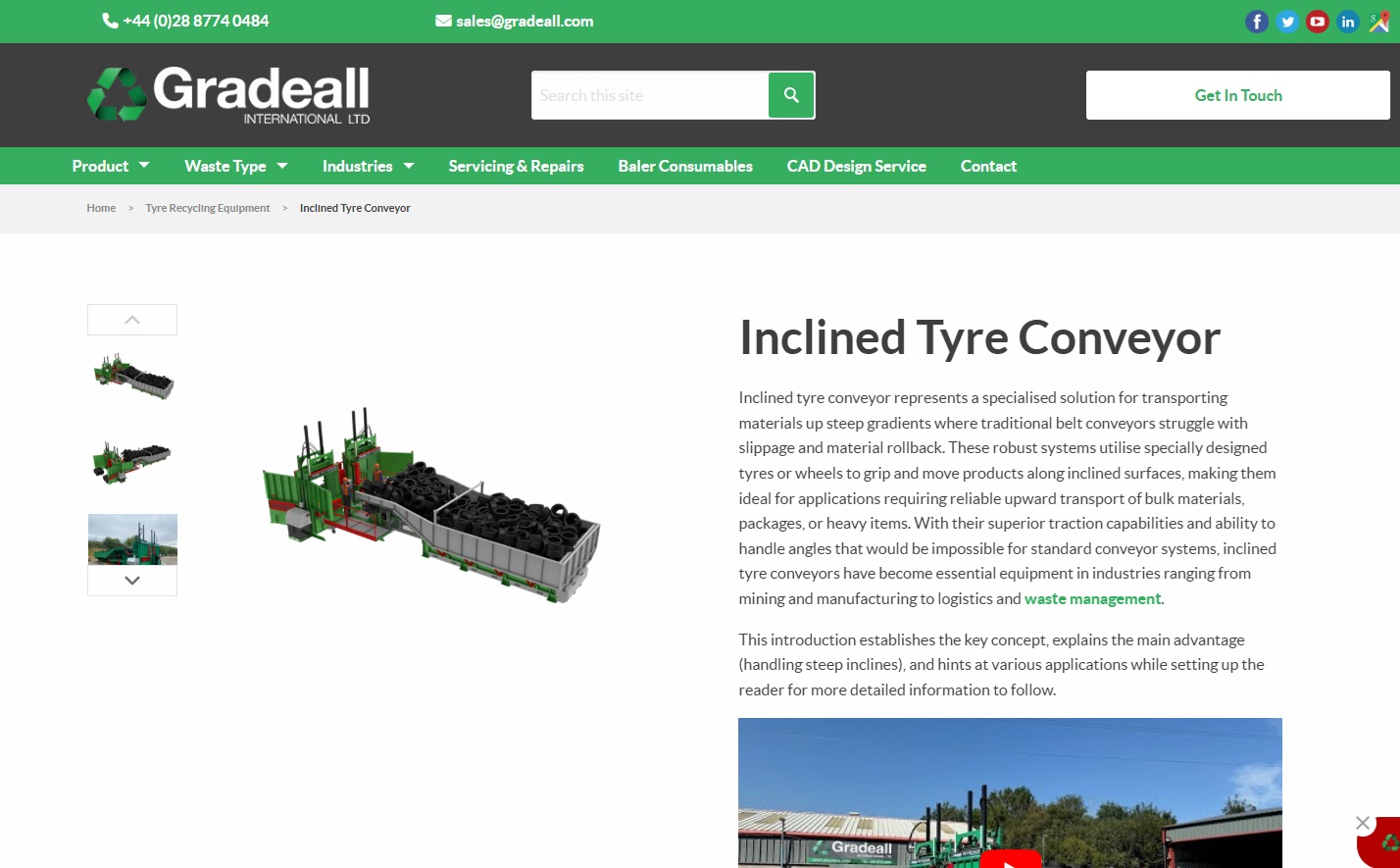
Inclined tyre conveyor represents a specialised solution for transporting materials up steep gradients where traditional belt conveyors struggle with slippage and material rollback.
tyre recycling equipment experts - Gradeall International
tyre recycling equipment experts - Gradeall International Tyre Recycling Manufacturers
Electric Vehicle Transition Set to Accelerate Global Tyre Waste Challenge - gradeall.com
Industry analysis suggests heavier electric vehicles with higher torque will increase tyre wear rates, creating growing demand for processing
The Westminster Hall debate, held in April 2025, saw MPs from multiple parties raise concerns about the environmental and economic consequences of current tyre export practices. Approximately 350,000 tonnes of end-of-life tyres are shipped from the UK to India each year, where GPS tracking studies have shown they frequently end up in unregulated batch pyrolysis facilities operating with minimal environmental controls.
Tessa Munt MP, who led the debate, emphasised the need to rethink waste as a resource within the circular economy framework. The debate heard compelling arguments that Britain is essentially exporting economic value along with environmental problems, and that domestic processing would keep that value within the UK whilst ensuring tyres are handled to proper environmental standards.
"The Parliamentary attention to tyre recycling reflects growing recognition that this sector represents genuine economic opportunity," says a spokesperson for Gradeall International. "We've been manufacturing tyre recycling equipment for nearly 40 years, and we're seeing increased enquiries from businesses evaluating investment in domestic processing capacity."
Current Export Practices Under Scrutiny
The UK generates approximately 600,000 tonnes of end-of-life tyres annually, creating one of the most significant waste streams requiring specialist processing. Of this substantial volume, roughly 350,000 tonnes are currently shipped to India, with additional quantities exported to Turkey and Morocco for use in cement manufacturing. Only a portion is processed domestically to create materials for asphalt, construction applications, and other end uses.
The Parliamentary debate highlighted disturbing evidence that many exported tyres end up in primitive pyrolysis operations that produce high-sulphur heavy fuel oils and low-grade carbon black whilst releasing harmful emissions without adequate filtration. These facilities operate under environmental regulations far less stringent than those applicable in the UK, creating pollution problems that would not be permitted domestically.
MPs pointed to significant deficiencies in the current regulatory framework governing tyre exports. End-of-life tyres are classified as "green list waste" under waste shipments regulations, enabling export without the notification and consent procedures required for hazardous materials. This classification, several MPs argued forcefully, fails to reflect the environmental harm caused when tyres are processed in inadequate overseas facilities.
Evidence presented during the debate included GPS tracking studies that followed exported tyres to their ultimate destinations. These studies revealed that tyres shipped from the UK consistently ended up in unregulated facilities, contradicting claims that exports go to properly managed processing operations. The tracking evidence provided concrete documentation of a problem that industry observers had long suspected.
The debate referenced Australia's approach as a potential model for UK reform. Four years ago, the Australian Government introduced legislation requiring waste tyres to be shredded before export, backed by strict licensing and verification schemes under the Recycling and Waste Reduction Act 2020. This approach has driven investment in Australian domestic processing facilities whilst ensuring any exported material meets minimum processing standards before leaving the country.
The Economic Case for Domestic Processing
The £250 million figure cited in Parliament represents the potential economic value of processing tyres domestically rather than exporting them as whole units for overseas processing. This substantial value derives from multiple revenue streams that currently benefit overseas economies rather than British businesses and workers.
Recovered rubber from processed tyres finds applications in playground surfaces, athletic tracks, rubberised asphalt for road construction, and moulded rubber products. Steel wire extracted from tyres supplies construction and manufacturing sectors with valuable secondary raw materials. Textile fibres recovered during processing find various industrial applications. Even the energy content of tyres can be recovered through controlled combustion in cement kilns and power generation facilities.
Sarah Dyke MP highlighted local businesses already operating successful tyre recycling operations within the UK, including facilities that recycle tyres into new rubber products for domestic and export markets. These existing businesses demonstrate conclusively that domestic processing is both technically and economically viable with appropriate equipment and market development support.
Employment creation represents another significant economic benefit that would flow from expanded domestic processing capacity. Processing facilities require skilled operators to run machinery, maintenance technicians to keep equipment functioning optimally, logistics personnel to manage material flows, quality control staff to ensure output specifications, and administrative support. The recycling sector more broadly has been identified as a growth area for employment as circular economy policies drive demand for waste processing capacity across multiple material streams.
Investment in tyre recycling equipment provides businesses with productive assets that generate ongoing returns through processing fees charged to tyre collectors, revenue from material sales to end users, and reduced disposal costs compared to alternative waste management approaches. Professional tyre baling machinery typically pays for itself through operational savings and revenue generation within reasonable payback periods, making the investment case increasingly attractive as processing volumes grow.
Environmental Harm from Current Practices
Beyond economic considerations, the Parliamentary debate highlighted serious environmental concerns associated with current export practices that proper domestic processing would address. The risks of burning tyres and pollution from inadequate processing facilities affect communities far from the UK but result directly from British waste exports.
Batch pyrolysis operations in destination countries often lack the emission control equipment required in developed markets. These facilities release harmful compounds into the atmosphere, contaminating air quality for surrounding communities. The high-sulphur fuel oils produced as byproducts create additional pollution when burned. Low-grade carbon black produced without proper quality control has limited applications and may itself become a waste disposal problem.
Properly managed tyre recycling within the UK would operate under stringent environmental regulations with enforcement by the Environment Agency. Emissions would be controlled to UK standards, protecting both workers and neighbouring communities. Waste streams would be properly managed rather than creating secondary pollution problems.
The transport emissions associated with shipping tyres to distant processing locations represent additional environmental cost. Moving hundreds of thousands of tonnes of material by sea to India generates significant carbon emissions that domestic processing would eliminate. Whilst transport emissions may seem secondary to processing emissions, they represent avoidable environmental impact.
Equipment Solutions for Expanded Domestic Capacity
Gradeall International has been manufacturing tyre recycling equipment in Northern Ireland since the early 1990s, building expertise through thousands of machine installations worldwide. The company's range addresses the full spectrum of tyre processing requirements, from initial collection and volume reduction through to material separation and preparation for end markets.
The MKII Tyre Baler produces PAS 108-compliant bales at rates of four to six per hour, with each bale containing approximately 100 car tyres depending on size. PAS 108 compliance ensures bales meet British Standards Institution specifications for use in construction applications including road foundations, slope repairs, and drainage systems. The baler reduces tyre volume by up to 80%, dramatically improving storage efficiency and reducing transport costs for moving processed tyres to end users.
For commercial vehicle tyres, which present particular processing challenges due to their size and weight, the Truck Tyre Baler handles larger dimensions whilst maintaining processing efficiency. Producing bales containing up to 12 truck tyres, this machine reduces volumes to 15-20% of original size, cutting transport requirements by up to 70% compared to moving loose tyres.
The Truck Tyre Sidewall Cutter addresses a particular challenge in tyre recycling by separating sidewalls from tread sections on large tyres. This separation makes tyres significantly easier to bale and prepares them for further processing. The sidewalls and tread sections can be processed separately, optimising material recovery from each component. The Car Tyre Sidewall Cutter performs similar functions for passenger vehicle tyres at smaller scale.
For facilities requiring maximum throughput to handle large volumes economically, the Inclined Tyre Baler Conveyor integrates with MKII Balers to process up to 850 tyres per hour. The conveyor brings tyres to operators at chest height, reducing physical strain and improving productivity compared to manual loading from ground level. This ergonomic design addresses workplace health and safety concerns whilst significantly increasing processing capacity.
Material separation equipment including the Tyre Rim Separator efficiently removes steel rims from rubber tyres, maximising recovery value from both components. Clean separation supports the production of higher-quality rubber feedstock for recycling applications whilst recovering steel that commands good prices in scrap metal markets. This separation capability proves essential for operations targeting material recovery rather than simple volume reduction.
The OTR Tyre Cutting Equipment range handles the most challenging large tyres from mining and agricultural applications. Off-the-road tyres can weigh several tonnes and present significant handling challenges that standard equipment cannot address. Gradeall's OTR Tyre Splitter and OTR Tyre Sidewall Cutter reduce these massive tyres to manageable segments suitable for further processing or specialist disposal.
Circular Economy Policy Context
The Parliamentary debate took place against a backdrop of evolving circular economy policy at both UK and European levels that increasingly supports domestic processing over export. The UK Government has placed circular economy principles at the heart of its waste management agenda, with a Circular Economy Taskforce established and expected to report during 2026 with recommendations for policy development.
The Environment Act 2021 provides the legislative framework for waste management reform in the UK, establishing powers to address waste crime and strengthen recycling requirements. MPs noted during the debate that implementation of measures to close loopholes enabling waste crime has been slower than anticipated, with multiple consultations conducted but limited concrete action taken. The debate called for action rather than continued consultation on reforms that have been discussed for years without resolution.
At European level, the Clean Industrial Deal published in 2025 prioritises circularity and access to materials as central to industrial strategy. A Circular Economy Act expected in 2026 aims to boost demand for recycled materials and strengthen the internal market for waste and circular materials. EURIC and ETRMA have called for harmonised End-of-Waste criteria for rubber from end-of-life tyres to support material flows across the European recycling sector.
These policy developments create a supportive environment for investment in domestic tyre recycling capacity. Businesses establishing processing facilities now will be positioned to benefit from strengthened circular economy frameworks and growing demand for recycled materials as policies translate into market requirements.
Industry Response and Investment Climate
The Tyre Recovery Association has welcomed Parliamentary attention to the sector, calling on Government to further tighten export controls, end T8 exemptions that enable waste crime, and actively support circular economy development through domestic processing infrastructure. The Association suggests 2026 could represent a crossroads for UK tyre recycling policy, with decisions made this year shaping the sector's development for decades.
Equipment manufacturers including Gradeall International report growing enquiries from businesses considering investment in tyre processing capacity. The combination of regulatory pressure on exports, economic opportunity from domestic processing, and circular economy policy support has created favourable conditions for infrastructure investment that did not exist even five years ago.
Potential investors include existing waste management companies seeking to expand into tyre processing, tyre retailers and wholesalers looking to vertically integrate their operations, entrepreneurs identifying the sector as a growth opportunity, and local authorities considering in-house processing to reduce disposal costs and generate revenue.
Gradeall's manufacturing facility in Dungannon, County Tyrone, produces the full range of tyre recycling equipment for both domestic and international markets. The company has been building tyre balers and processing equipment since the early 1990s, with machinery now operating at customer sites worldwide from Iceland to Australia, demonstrating proven performance across diverse operating conditions.
After-sales support includes service engineers operating across the UK and Ireland, providing responsive assistance for equipment maintenance and repair. Remote monitoring capabilities enable health checks on machinery at any location, allowing engineers to diagnose issues and provide guidance without necessarily requiring site visits. Service and preventative maintenance contracts provide ongoing support throughout equipment lifecycles, ensuring machines maintain optimal performance.
Looking Ahead
The Parliamentary debate has placed tyre recycling firmly on the political agenda, with MPs from multiple parties expressing support for reforms that would drive investment in domestic processing capacity whilst ensuring environmental standards are maintained throughout the tyre lifecycle.
Whether Government responds with legislative reform or continues the consultation approach that has characterised recent years remains to be seen. The Tyre Recovery Association and other industry bodies continue pressing for concrete action rather than further discussion. The economic and environmental case for expanding domestic tyre recycling capacity appears increasingly compelling to policymakers across the political spectrum.
Businesses considering investment in tyre recycling equipment can draw confidence from the clear policy direction of travel. Circular economy frameworks are strengthening across UK and European markets, export loopholes face growing political pressure for closure, and demand for recycled materials continues to grow as manufacturers seek sustainable supply chains. Facilities established now will be well positioned to benefit as these trends develop and mature.
The £250 million opportunity identified in Parliamentary debate represents genuine economic potential waiting to be captured by British businesses willing to invest in processing infrastructure. With appropriate equipment and market development, the UK tyre recycling sector could transform from an export-dependent activity into a thriving domestic industry generating employment, environmental benefits, and economic value for communities across the country.
FREQUENTLY ASKED QUESTIONS
What did the UK Parliament debate about tyre recycling?
The April 2025 Westminster Hall debate addressed concerns about UK tyre exports to countries with lower environmental standards, the economic opportunity of domestic processing, and potential reforms to waste shipment regulations. MPs called for tighter export controls and active support for circular economy development through domestic infrastructure investment.
How much could domestic tyre recycling be worth to the UK economy?
A study cited during Parliamentary debate suggested domestic tyre processing could generate £250 million annually for the UK economy, compared to approximately £13 million from current export practices. This value comes from recovered materials including rubber, steel, and textiles, processing services, and employment creation across the sector.
Where are UK tyres currently exported?
Approximately 350,000 tonnes of end-of-life tyres are exported annually from the UK to India, with additional volumes going to Turkey, Morocco, and other destinations. GPS tracking studies presented during the Parliamentary debate showed many exported tyres end up in facilities with limited environmental controls rather than properly managed processing operations.
What is the Australian model for tyre exports?
Australia introduced legislation in 2020 requiring waste tyres to be shredded before export, backed by strict licensing and verification schemes under the Recycling and Waste Reduction Act. This approach has driven investment in Australian domestic processing facilities whilst ensuring any exported material meets minimum processing standards.
What equipment is needed to start tyre recycling?
Basic tyre recycling operations require a tyre baler to compress tyres into manageable bales for transport and storage. Larger operations may add sidewall cutters for processing truck tyres, rim separators for material recovery, and conveyor systems for increased throughput.
Conor Murphy
Gradeall International Limited
email us here
Visit us on social media:
LinkedIn
Facebook
YouTube
X
Other
Gradeall G140 Pre-Crush Compactor | Waste Compactor | Waste Management | Northern Ireland
Legal Disclaimer:
EIN Presswire provides this news content "as is" without warranty of any kind. We do not accept any responsibility or liability for the accuracy, content, images, videos, licenses, completeness, legality, or reliability of the information contained in this article. If you have any complaints or copyright issues related to this article, kindly contact the author above.
